Twenty years ago this month, in September 2006, I introduced the A.I.R. Model in my first book, If You Can’t Say Something Nice, What DO You Say? It was my answer to this question:
How do I tell someone that what they’re doing is a problem, without destroying the relationship?
Two decades later, people are still asking that question. When I present my book-related keynote, “If You Can’t Say Something Nice, What DO You Say?,” I challenge audiences to think of a situation they’ve been avoiding. Most of us would rather not have an uncomfortable conversation with a coworker, or anyone else for that matter.
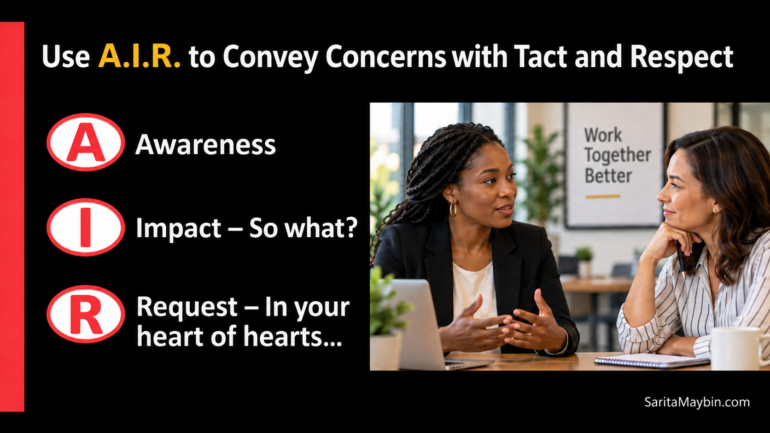
Clear the Air with A.I.R.
Awareness: Do they know that what they’re doing is a problem? Start by assuming they don’t. That one assumption affects the tone and words you choose.
Impact: What is the negative effect of the behavior? This is where you explain how it affects you, the team, or the work.
Request: What would you like them to do differently in the future? Notice that this is a REQUEST, not a DEMAND.
Revisiting the 2006 Book
Here are two dilemmas from my first book, along with the possible replies I offered then. And these concerns are still common today, so the solutions still apply.
Dilemma: “My coworker is always complaining and it’s starting to drag everyone down.”
Possible reply:
- Awareness: “I’ve noticed that you frequently mention what’s wrong with this department…”
- Impact: “…and it’s starting to negatively affect some of our attitudes about working here.”
- Request: “Can we focus instead on what’s right in our department?”
Or:
- Awareness: “It seems like we spend hours every day discussing the downsizing…”
- Impact: “…and it’s starting to become depressing.”
- Request: “I’d rather talk about what our options are.”
Dilemma: “My colleague keeps interrupting me when I’m talking at meetings.”
Possible reply:
- Awareness: “I don’t know if you’re aware of it; at meetings you often start talking before I’m finished.”
- Impact: “I find the meetings to be unproductive when more than one person is trying to talk at the same time.”
- Request: “At the next meeting, would you be willing to go for one person speaking at a time?”
Or:
- Awareness: “I’m sure you didn’t realize it, but at the meeting this morning, you interrupted me several times.”
- Impact: “It made me feel like you didn’t want to hear what I had to say.”
- Request: “I’d really appreciate your hearing me out next time.”
Good NEWS NOTE About A.I.R.
A.I.R. doesn’t have to sound like three separate steps.
The replies about complaining flow as one or two natural sentences. Some people worry that using a model will make them sound scripted. It doesn’t have to. A.I.R. is a guide for what to say, not a speech to memorize.
The Request doesn’t have to be a question.
“Would you be willing to…” is one of my favorite phrases, and it’s in there. And “I’d rather talk about what our options are” is a request too. Sharing your preference invites cooperation without sounding like an order.
A New Dilemma for 2026
Twenty years ago, few people were getting work messages at 11 p.m. on their phone. Today, it’s one of the most common frustrations I hear from audiences. Fortunately, A.I.R. works here too, even when the person you’re talking to is the boss.
Dilemma: “My team lead sends messages at 11 p.m., and now everyone feels like they have to answer right away.”
Possible reply:
- Awareness: “Perhaps you didn’t realize that when messages come in late at night, people feel they need to reply right away.”
- Impact: “I’m concerned that we’re all starting the next day tired, and that’s not good for any of us.”
- Request: “Would you be willing to schedule your messages to send in the morning, or let us know when something can wait?”
A.I.R. ACTION PLAN
Sometimes it IS hard to speak up. We might stay silent for months, hoping the problem will go away, and then blurt it out at the worst possible moment. A.I.R. gives you a middle path: honest, direct, and nice.
So, think about the concern you’ve been carrying around. What does the other person need to be aware of? What’s the impact? And what, in your heart of hearts, would you like them to do differently?
Answer those three questions, and you may find that clearing the air is a lot less stressful than holding your breath.
More on the A.I.R. Model
I first introduced the A.I.R. Model in my 2006 book, If You Can’t Say Something Nice, What DO You Say?
In 2009, CBS News MoneyWatch featured A.I.R. as a better alternative to the dreaded “compliment sandwich.” And it still is.
See keynote excerpt In 59-second YouTube video clip “Questions to Ask Yourself Before a Difficult Conversation”
For more A.I.R. phrases, see my December 2025 blog post, “How to Make Difficult Conversations Less Difficult Using the A.I.R. Model”